
China's Economic Slump
Can it still challenge the Status Quo?

Approx reading time: 12 mins
Disclaimer: these letters are purely for educational purposes and the odd laugh. Don’t chastise me because it certainly isn’t advice, merely a summary of my observations…
Greetings from a small village in the Swiss Alps!

In my previous Op-ed, I discussed an overarching view of a rapidly evolving World Order, presenting China as the central protagonist in the shifting power dynamics between East & West. Given the numerous recent articles & media attention on China’s economy, it felt like a good time to take a closer look, and see whether China’s influence is diminishing. I hope this short summary offers readers a more holistic perspective that goes beyond the data. If you enjoy reading this, please take a moment to subscribe, it’s free.
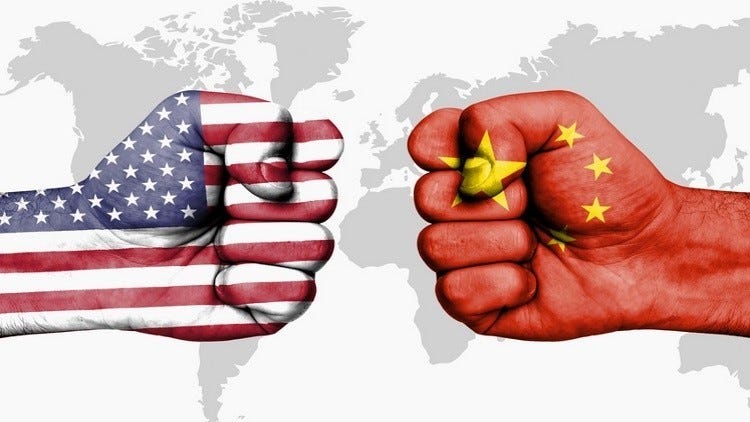
I repeatedly hear – from smart folks – that China fears are overblown; asserting that China will not succeed in challenging the existing order, the Yuan will never replace the US$ and that Chinese military strength is exaggerated. That the US will continue to dominate global innovation for decades to come. And that ultimately, the state of China’s economy and unpredictable regulatory environment has considerably delayed its ability to close the gap with the US and its allies.
Maybe all this is true…
But there are many forces at play, and because of the complexity of variables, speaking with authority and in absolute terms - especially in a short essay - is a futile exercise at best. With that in mind, let’s jump right in…
It’s no secret that China has been experiencing a material slowdown in growth. Indeed, with 2023 GDP forecasts pinned around 4-5%, we are a far cry from the average YoY growth of ~9% observed the last 35 years.
But what it boils down to for me, is whether China’s current economic slump is a large enough catalyst to derail its growing sphere of influence, jeopardizing the trajectory of its bigger plan.
TLDR: In my view, unlikely.
Why is this question so important to me?
Because I spend a lot of time contemplating on longer term asset allocation in the face of a changing global order. As a skeptic of the prevailing status quo, I find that embracing a multi-disciplinary approach to research offers a more valuable method for exploration and understanding, especially when compared to traditional bank research which is usually narrow focused. I.e. Delving deeper into technology, history, politics and central bank policy, and mating them with my passion for game theory and behavioural economics, beyond the realm of investing. Super niche… I know…
In any case, I firmly believe we are entering a significantly more complex world, where investment decisions will demand insights that extend beyond conventional research.
Markets often have short term memories, and our tendency to focus on immediate time frames may hinder our understanding of China’s grander strategy. By considering their current economic duress within a broader historical and geopolitical context, we are more likely to grasp the magnitude of China’s long-term vision - and assess for ourselves whether its influence is indeed receding, or not.
But before we start contextualizing, lets first summarise China’s current economic state… How bad is it? In two words… pretty bad.
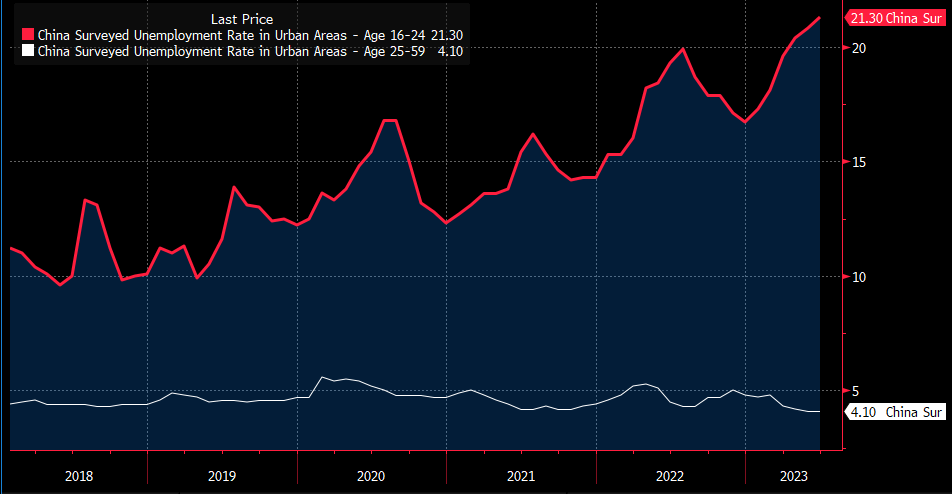
Latest data shows a record unemployment rate of 21% for 16 to 24-year-olds which implies shrinking opportunities for the forthcoming generation. Notice how the unemployment rate has surpassed the period of peak COVID stress:
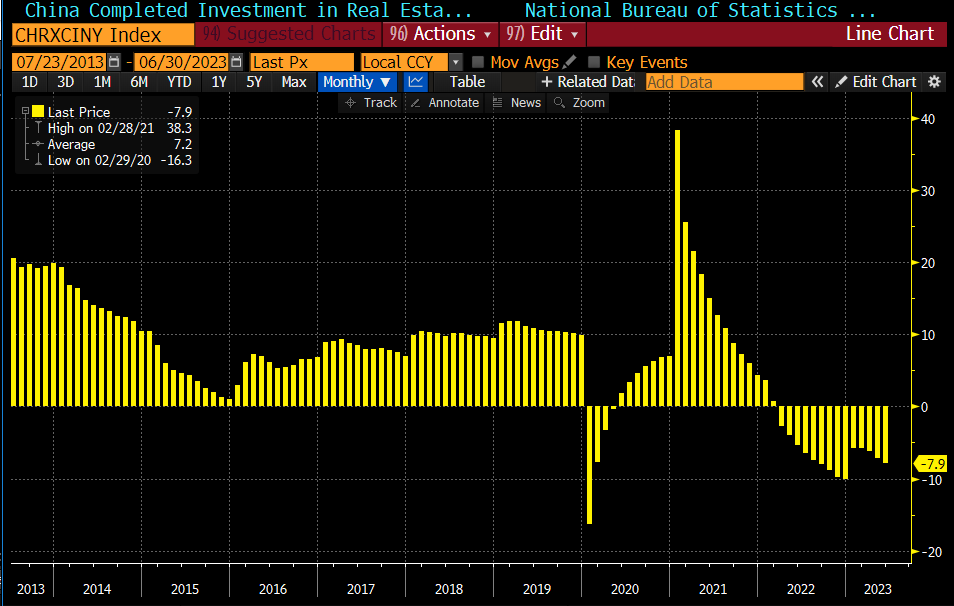
It’s property sector is decimated, with investments -15% YoY. Notice here a declining trend that is far “stickier” than the sharp but short decline experienced during COVID:
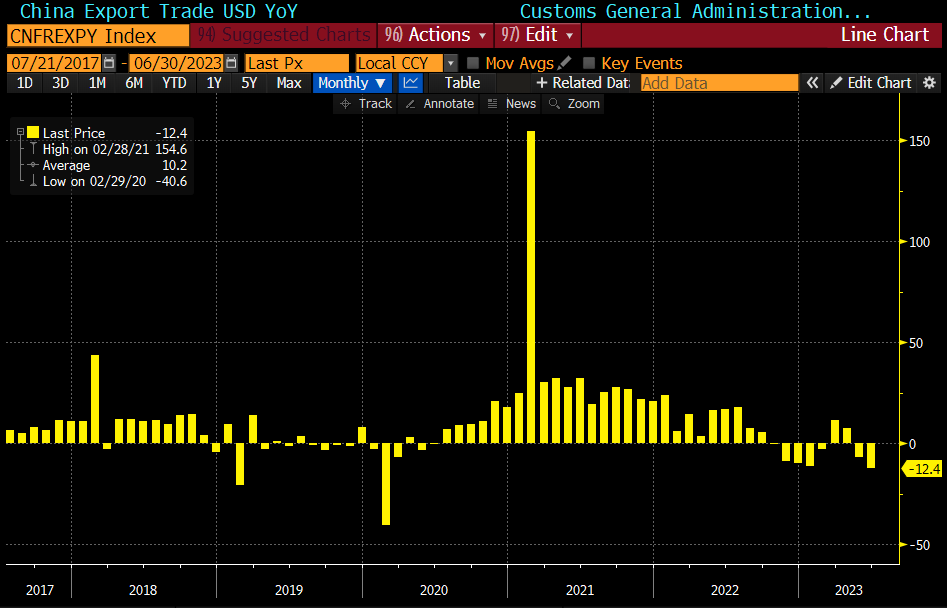
Exports are -12% YoY (the most in 3 years), as demand faltered due to central banks raising interest rates to curb inflation… and this is despite leadership efforts to sustain a post-COVID recovery:
Imports are -7% YoY reflecting persistently weak domestic demand:
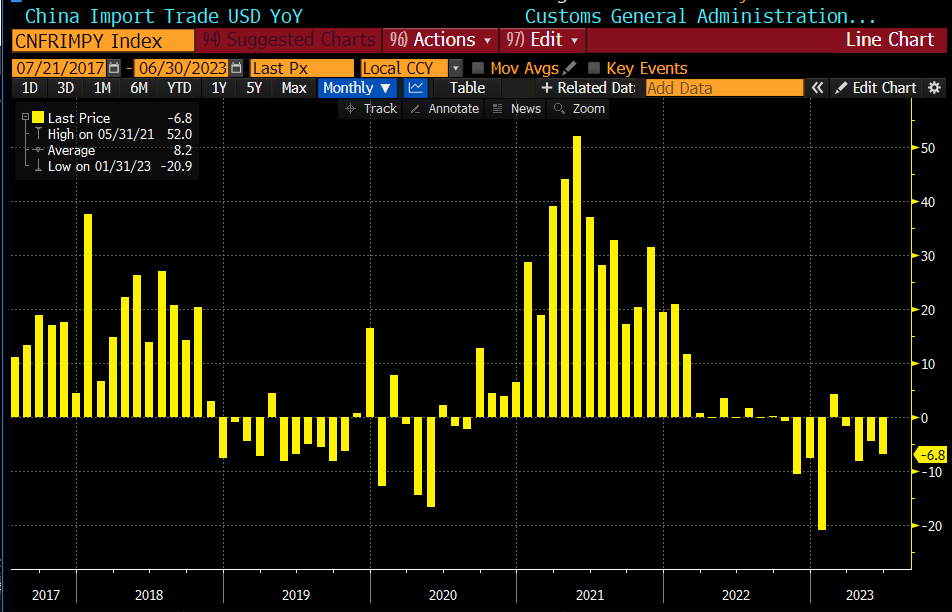
You get the idea…
In summary, most of today’s economists anticipate a necessary implementation of a fiscal push to lift the economy out of its current crisis. I tend to agree..
But amidst this grim picture, I find myself wondering whether it truly validates this growing perception of weakening influence versus the mighty West. If this perception is accurate but fundamentally flawed, we may suffer the consequences of our ignorance in the future. Assessing our position on this curve is a useful exercise, because it gives us more tools to strategically plan for the long-term in terms of policies and investments.
A Clash of Cultures
China’s formidable transformation is deeply rooted in its rich history & cultural values, so this is a great starting point.
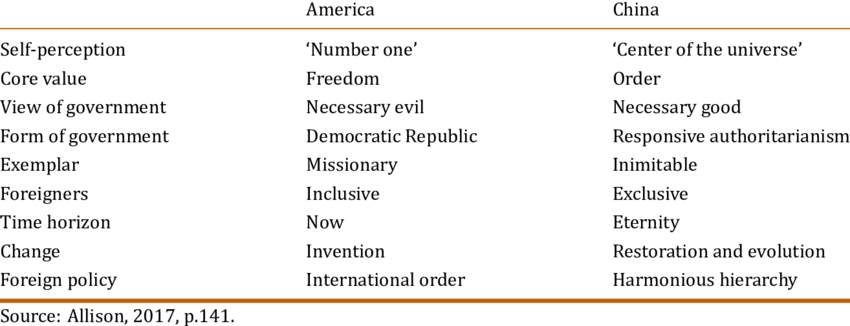
Culturally, China and the West exhibit stark differences. As such, the sensibility of policies tends to vary depending on the perspective through which they are viewed.
Though China and the West engage in trade and diplomacy, they maintain fundamental differences in their respective systems. And while globalization has helped facilitate transactions, it hasn’t erased the inherent fault lines that persist.
Also, this concept of a “universal civilization” is entirely a Western notion, in direct contrast to the particularism prevalent in most Asian societies that are heavily influenced by the teachings of Chinese philosopher Confucius.
These cultures tend to focus on systems that emphasize authority, hierarchy, the subordination of individual rights and interests, the significance of consensus, the avoidance of confrontation and the dominance of the state over society and the individual.
In stark contrast, the ideals of the US and its allies are grounded on principles of liberty, equality, democracy, and individualism. In the US in particular, the American mindset entails a propensity to distrust the government, challenge authority, advocate for checks and balances, foster competition, and prioritize human rights.
Furthermore, China’s perception of external affairs is merely an extension of its concept of internal order. To quote Confucius:
“There are not two suns in the sky, there cannot be two emperors on earth”.
Xi Jinping’s China believes that a strong centralized authority is vital for harmony and stability, both within the country and in its interactions with the outside world:
Xi Jinping & Making China Great Again
Now that we’ve understood some of the main cultural differences, lets integrate them with history to understand the scale of its greater plan.
When the Party took over in 1949, China was caught up in a civil war and had experienced foreign aggression. The average life expectancy was just 41 years. So, while the US was actively shaping the new world order, China was left behind & irrelevant - it didn’t have a voice.
The Chinese have a phrase that captures the essence of this period. It has since become a mantra to its people, nurturing a sense of patriotism rooted in historical humiliation and demand for payback:
“Wuwang guochi” ——— Never forget our national humiliation.
Between 1981 and 2004, China succeeded in lifting half a billion people out of extreme poverty. Remember, just a generation ago, roughly 90% of Chinese lived on < $2 a day. Today, 98% of the population is > the poverty line.
“The greatest Chinese dream, is the great rejuvenation of the Chinese people”
Xi Jinping, 2012
China leads the BRICS, and the BRICS are getting stronger.
In the aftermath of the GFC – Global Financial Crisis (2008) – China organised the BRICS comprised of Brazil, Russia, India, China, South Africa. A group of rapidly expanding economies that sought to advance their sphere of influence, making collective decisions without the “blessing” of the United States, its allies, or the G7.
Fast forward 15 years, and an increasing number of countries are striving for greater autonomy from the US financial system. As a result, the BRICS nations are displaying a growing interest to develop a new currency to challenge the dominance of the US$; a view that has intensified due to the recurring weaponization of the US$ in the form of sanctions & trade wars.
Don’t be silly you say.. US$ is King!
Maybe..
But I remind you that in 2021, Saudi & Russia signed a military cooperation agreement that meant the US was no longer the sole protector of the Saudi Kingdom. At this year’s World Economic Forum in Davos, Saudi’s Finance Minister announced the country was open to trading in other currencies in addition to the US$ - something they haven’t done in nearly 50 years. In 2022, Putin announced the bloc was working to create an international reserve currency; a topic that will no doubt be on the agenda at the 15th annual BRICS summit later this month…
So the BRICS sphere of influence, led by China, continues to increase regardless.
Thucydides Trap
China's remarkable journey highlights an unwavering determination to ascend as a global superpower. This unfolding scenario embodies the concept of Thucydides Trap, coined by Harvard professor Graham Allison and further expanded in his fantastic book "Destined For War" – I highly recommend it to anyone seeking insights into motives and historical parallels.
Thucydides’ Trap refers to the likelihood of conflict between an established power (USA) and a rising power (China) when their interests intersect. This often leads to unwanted confrontations that ultimately result in military conflict.
As Greek historian Thucydides highlighted in his recounting of the Peloponnesian Wars, “it was the rise of Athens and the fear that this instilled in Sparta that made war inevitable”.

This is not something new. You see, throughout history, collision courses between a dominant power and a rising challenger have been a recurring and enduring dynamic.
Fast forward a couple of thousand years and we face a similar situation…
Now - I’m not implying we’re heading towards military conflict – but history warns us it wouldn’t be unreasonable to think we might.
China’s demand for recognition and respect became quite evident in 2013, following years of resistance from the US to cede to Chinese demands for increased voting rights at the World Bank. Fed up with not being heard, China stunned the world by establishing its own version, the Asian Infrastructure Investment Bank (AIIB). Despite enormous controversy, 57 countries signed up before it even launched, including US allies like the UK (!), all hoping to reap the benefits of cheaper infrastructure loans….
But…
Even before the AIIB was established, China’s Development Bank had already surpassed the World Bank as the largest financier of infrastructure/development projects. By 2016, global Chinese development projects were a staggering $130 billion larger than the next SIX major Western counterparts... combined. Incredible, no?
While China’s ascent & explosive growth is hardly “new” information, they seem to be forgotten; you never read about them in traditional research. So I include these condensed snippets of history to help paint a picture of the scale we’re working with.
How fast and hard was China’s ascent to become the de-facto number 2 superpower?
Well – it sort of feels like Rome may have been built in a day.
Between 2011 and 2013, China both produced and consumed more cement than the United States did in the entire 20th century… China built the equivalent of Europe’s entire housing stock in just 15 years… And even at its lower growth rate at the middle of the last decade, China was creating a “Greece” every two weeks.

Shortly after taking power in 2012, Xi unleashed a multi-decade infrastructure project called One Belt, One Road (OBOR) that would essentially export China’s excess industrial capacity through a transportation & railway network spanning most of Eurasia. Beyond trade benefits, OBOR served as a means for China to project power across several continents, integrating countries and ultimately tilting the balance of geostrategic power to Asia…
As Xi told Eurasian leaders almost a decade ago: “In the final analysis, it’s for the people of Asia to run the affairs in Asia, solve the problems of Asia and uphold the security of Asia”…
The result? Asia is already witnessing a progressively receding frontier of US dominance.
Size of Economy?

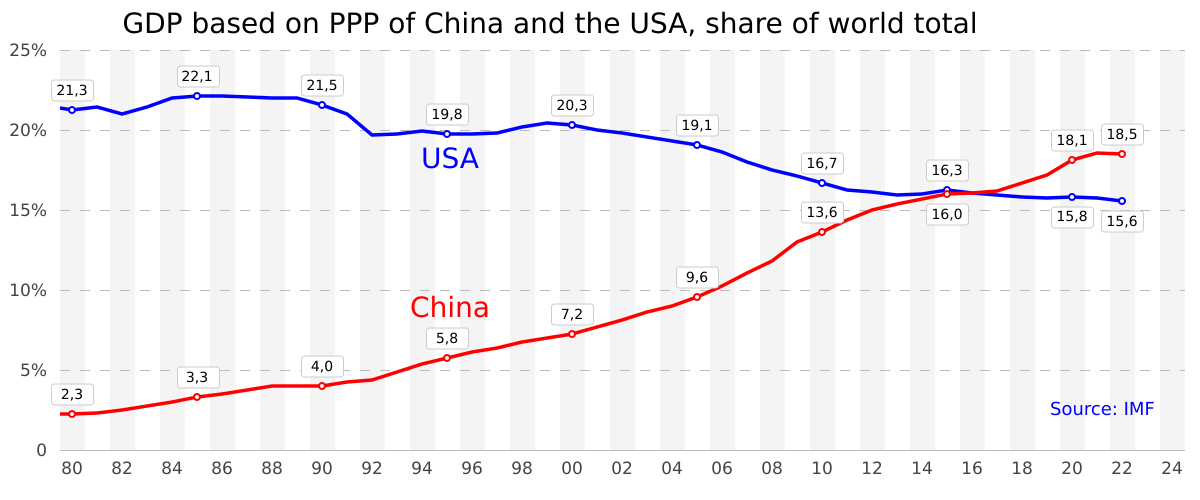
Let’s look at Purchasing Power Parity (PPP)– a tool us “macro-economists” (kek) look at that helps compare the purchasing power of currencies between different countries; it considers the real cost of goods and services. It helps us understand how much our money can actually buy in various places around the world. China’s GDP adjusted for PPP offers us a glimpse of normalised insight vs the US. As we can see, China has been ahead for the last 6 or so years:
Why is this important?
Because it indicates that, in terms of real purchasing power, China’s economy is bigger than that of the US of A.
A larger GDP at PPP suggests China’s people (on average), can afford more goods & services than their US counterparts, even if the nominal GDP (measured at current exchange rates) may be smaller. Finally, it also emphasizes China’s increasing economic influence & potential implications for global trade and politics.
A Military to Fight & Win ————“If nobody is afraid of me, I am meaningless”.
Since coming into power, Xi’s China has prioritised safeguarding his regime, creating an Orwellian surveillance state that enforces repressive laws under the banner of national security. A critical component to its success, is his control of the Military. He believed that part of the reason the Soviet Union fell was due to Gorbachev’s decision to “nationalise” the Soviet forces, requiring commanders to swear allegiance to the State, rather than the Party. As a result, this left “the Party” unarmed – and this is exactly what Xi wanted to avoid. Having ensured military loyalty to his Party, he dramatically increased China’s military budget.
And this brings me to my next point:
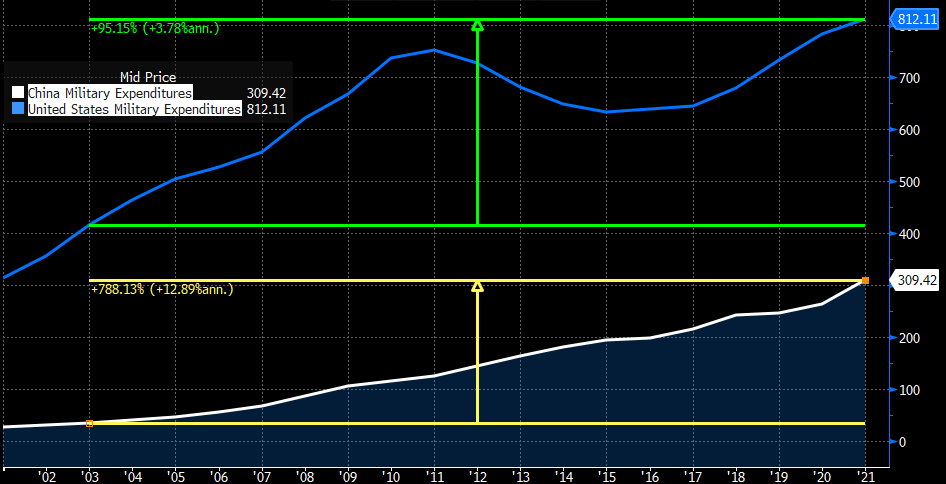
Observations in military growth & spending are quite telling. At first glance, it may appear that the US holds a massive lead in superiority given it spends more than the next 9 countries combined:
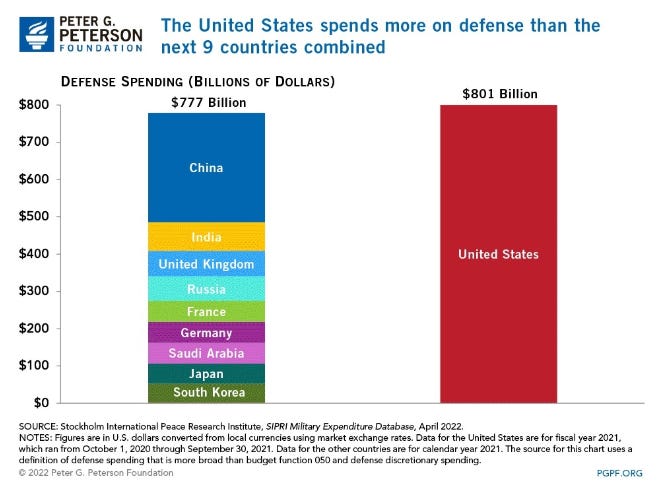
However, we must take into account that a large chunk of the US budget is used to finance 750+ bases & operations overseas (in c. 80 countries) -- more than any other empire in history. China… does not have this problem.
Therefore, in relative terms, the gap in innovation and superiority is likely far smaller than we think. China’s military expenditure has grown 800% over the past 2 decades, vs 100% for the US:
Technology & Innovation: Is the US really that far ahead?
A recent report released by the Australian Strategic Policy Institute- a thinktank that has been tracking the developments of 44 vital technologies over the past year - tells us that China leads in 37 of those. The fields include electric batteries, hypersonics and advanced radio frequency communications such as 5G and 6G. The US continues to lead in 7 technologies including vaccines, quantum computing and space launch systems. These findings were based on “high impact” research in critical and emerging technology fields.
“Our research reveals that China has built the foundations to position itself as the world’s leading science and technology superpower, by establishing a sometimes stunning lead in high-impact research across the majority of critical and emerging technology domains,”
Courtesy of the The Critical Technology Tracker (click on the link to play around), below is a snippet comparing China to the US in the Artificial Intelligence, Computing & Communications space:
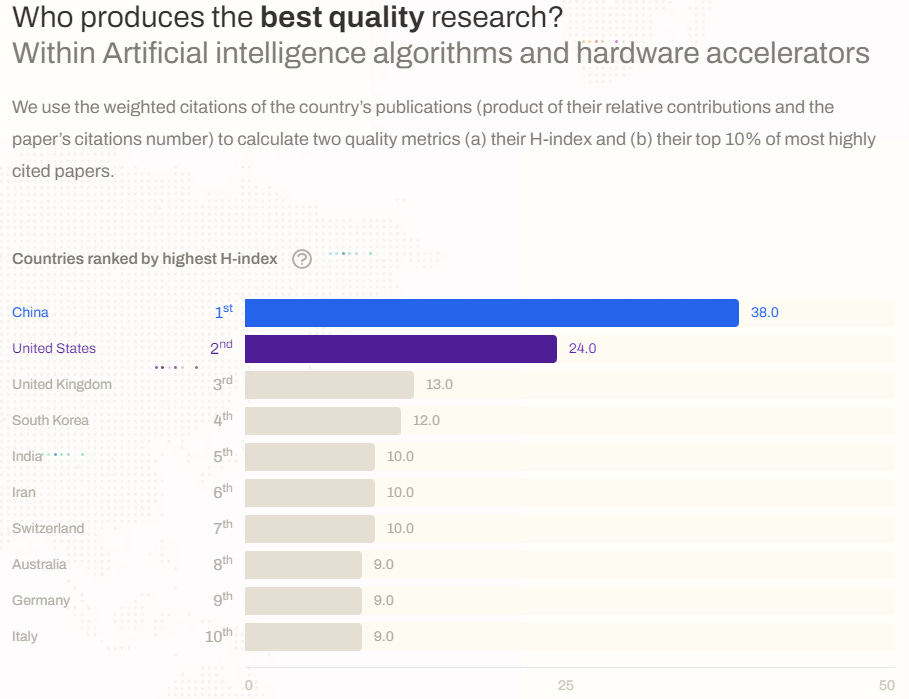
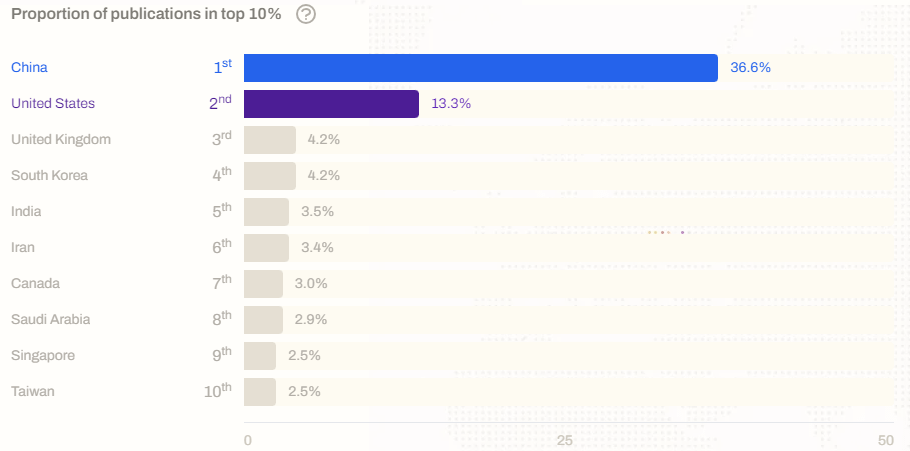
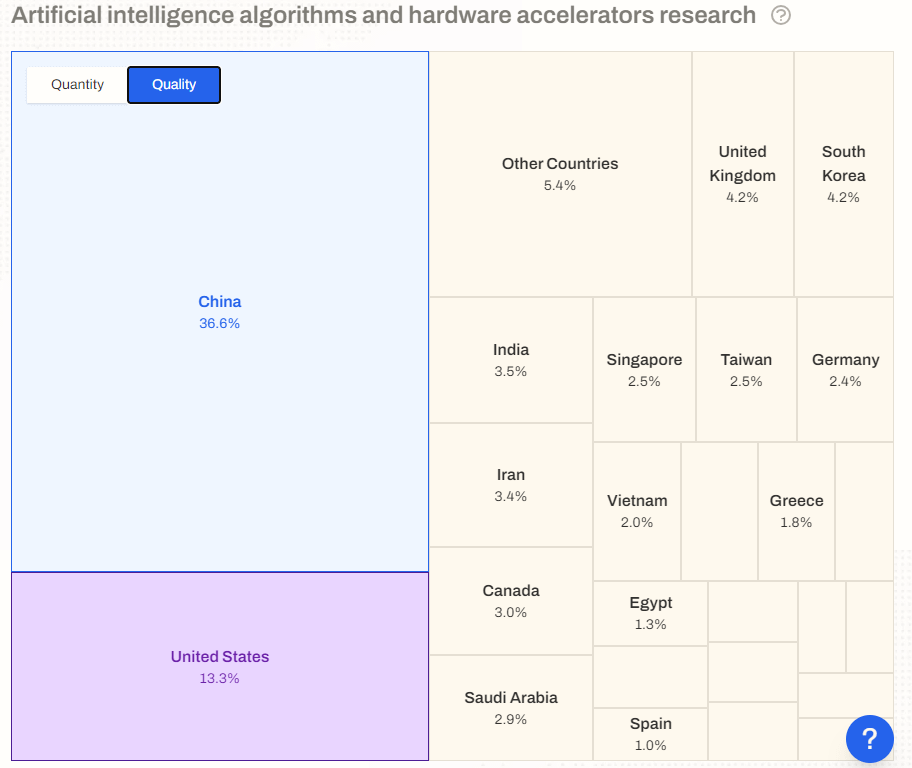
The perception that innovation is primarily dominated by the US could be attributed to its capitalistic nature, where large American corporations often lead in adopting and profiting from cutting-edge technologies (large language models, graphics cards, etc.). But it feels like we’re overlooking (and underestimating) China’s contributions and progress. Acknowledging China’s strides rather than just focus on markets is imperative if we wish to form an educated view.
So, to summarize
We are currently witnessing a global power struggle, as the shift from a unipolar to a multipolar world order is already in progress. China is the chief protagonist. And while its current economic condition may be deteriorating, the perception that it is losing influence might be flawed. Let’s not be blind sighted by our dogma of present circumstances otherwise we run the risk of missing the bigger picture.
Do we genuinely believe Xi is prepared to let China’s economy falter and take the risk of losing ground at this critical juncture?
I don’t think so…
Has China’s economic slump derailed its growing sphere of influence?
Doesn’t seem like it…
China is playing a well defined, and longer term game. It is driven by its political motivations and historical context that only reinforce an unwavering determination to succeed.
Think of it akin to walking your dog down a sandy beach.
It will undoubtably deviate from your path, zig zagging about you while it sniffs around. But that does not change the inevitable course you as the master are walking, nor the trajectory your little furry friend is ultimately following…